


TransferRoom’s Summer Window Review reveals changing spending patterns, rising demand for midfielders and the forces shaping the global transfer market.
The Premier League continues to dominate football’s global transfer market. In summer 2026, global spending reached a record €11.27bn, up 4.2% year on year. Premier League clubs accounted for €4.15bn, representing 36.8% of worldwide transfer expenditure.
English clubs also generated €2.59bn in transfer income, making the Premier League both the market’s biggest spender and its biggest earner.
But the headline figures tell only part of the story. Where are clubs directing their money? Which leagues are spending less? And what do the numbers reveal about changing recruitment priorities?
TransferRoom’s Summer Window Review report examines the data behind the deals, identifying the trends shaping recruitment and investment across the global game.
Beyond the headline figures
The latest window revealed contrasting spending patterns across major markets.
Saudi Arabia’s Pro League recorded the largest decline in spending on incoming transfers year on year, down €161.8m, or 25%. Brazil’s Série A followed with a decrease of €102m, while Bundesliga spending fell by €100m.
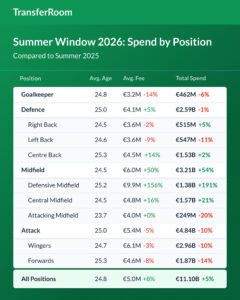
Elsewhere, investment in midfielders increased significantly. Spending on the position rose by 54%, driven in particular by demand for defensive midfielders, where spending increased by 191%.
The scale of that investment is reflected in deals involving players such as Elliot Anderson, Enzo Fernández and Sandro Tonali, whose combined transfer fees exceed €300m.
These figures reveal more than the scale of individual transfers. They highlight where demand is growing, where spending is slowing and which positions clubs are prioritising.
“Football has never spent more on transfers, but this isn’t a market where everyone is benefitting equally. More money is being concentrated in fewer leagues and bigger deals, while clubs are becoming much more selective about where they pay a premium” said Frederik Broholt, President of TransferRoom.
The major-tournament premium: more minutes, lower returns
Major international tournaments can put players on the radar of clubs around the world, but TransferRoom’s analysis suggests that signing players on the back of a tournament comes at a significant cost.
Players signed within six months of playing at least 180 minutes at a major tournament went on to play 18% more minutes for their new clubs over the following two years than comparable signings. But they also cost 65% more to sign.
That extra investment did not translate into stronger financial returns. Clubs recovered an average of just 47% of the original transfer fee when reselling post-tournament signings, compared with 67% for other paid signings.
The report estimates average return on investment at -6% for post-tournament signings, compared with +17% for other transfers. The findings underline the importance of looking beyond tournament performances when assessing a player’s value and long-term potential.
Turning market intelligence into better decisions
For clubs, understanding the transfer market involves more than tracking fees. Recruitment teams need to identify suitable players, assess realistic opportunities and act quickly, often while managing large volumes of information.
TransferRoom is a global transfer marketplace and decision intelligence platform for football. It connects verified clubs and agencies, giving football professionals access to transfer opportunities, market intelligence and tools designed to support recruitment and deal-making.
Its scouting and player-monitoring tools help clubs assess potential targets and bring relevant information together, supporting more informed and efficient recruitment decisions.
Financial planning is another challenge. Modern player contracts can include complex clauses, bonuses and conditional payments, making it important for clubs to understand their potential financial commitments.
TransferRoom’s Contingency AI helps clubs analyse contractual scenarios and understand potential obligations, supporting decisions around payments, renewals and budgeting.
As Beat Flückiger, Chief Financial Officer of BSC Young Boys, a TransferRoom customer, explained:
“You can easily miss a huge amount of money if you don’t have all the data together.”
Access to relevant information can help clubs identify opportunities, assess risks and make better-informed decisions in an increasingly complex transfer market.
Connecting football’s decision-makers
Technology is only one part of the transfer process. Relationships and direct communication between clubs and agencies remain central to identifying opportunities and completing deals.
TransferRoom also organises in-person events that bring football decision-makers together throughout the transfer calendar. These meetings allow clubs and agencies to discuss recruitment priorities, explore potential transfers and build relationships that can lead to deals.
The upcoming TransferRoom LIVE event in Lisbon on November 9–10 will feature discussions on football finance and AI, networking opportunities, an online session and the inaugural TransferRoom Awards. More than 500 club and agency representatives are expected to attend.
By combining a global transfer marketplace, decision intelligence tools and direct connections between football professionals, TransferRoom aims to make the transfer market more transparent, efficient and connected.

Powering 10,000 deals since 2017
Founded in 2017 by Danish entrepreneur Jonas Ankersen, TransferRoom was created to address a fundamental problem in football: despite billions being spent on transfers each year, clubs and agents lacked a transparent and efficient way to connect directly with relevant decision-makers.
“I founded TransferRoom because the transfer market was opaque and inaccessible to most clubs” said Ankersen.
Since its launch, TransferRoom has powered more than 10,000 deals. Its global network now spans 800 clubs, 130 leagues and 600 agencies.
The 10,000th deal came earlier this year, when Brayan León moved from Independiente Medellín to Mamelodi Sundowns. It followed the platform’s first deal in 2017, Jón Daði Böðvarsson’s move from Wolverhampton Wanderers to Reading.
Other notable deals associated with TransferRoom include Antoine Semenyo’s move from Bristol City to AFC Bournemouth and Viktor Gyökeres’ £25m club-record move from Coventry City to Sporting CP.
“TransferRoom’s platform gave us the opportunity to contact the selling club’s decision-makers directly and make our interest known in signing Viktor Gyökeres” explained Hugo Viana, Sporting CP’s Director of Football at the time.
Read more: TransferRoom reaches 10,000 deals and marks a new era for football decision intelligence